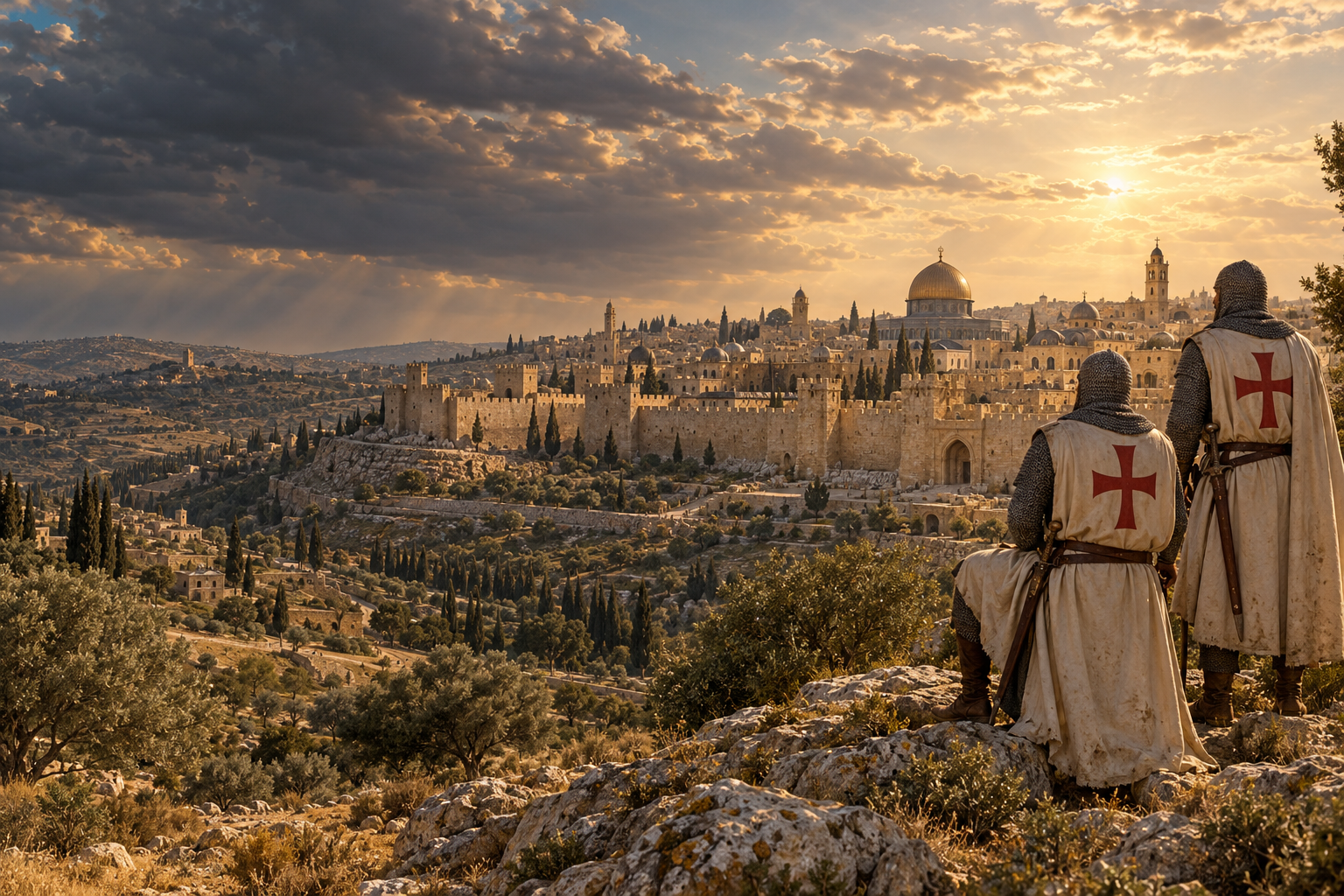
People, places and symbols behind a changing medieval kingdom.
A KINGDOM BEYOND ONE CITY
Faith, fortresses and a fragile crown
Jerusalem gave the kingdom its name. Ports, inland towns, religious communities and royal families made it more than one city. Explore the routes between its places and the people who shaped its story.
PLACES / CHANGING FRONTIERS
A kingdom connected by coast, roads and castles
Follow the shift from Jerusalem to Acre. Choose a date to see the story change.
Original schematic orientation map. Positions are approximate; markers do not show exact borders or continuous control. Circles are towns; squares are castles.
c. 1180 · Jerusalem and the wider kingdom
Jerusalem was the royal and spiritual centre, connected to coastal ports and inland strongholds. The kingdom’s reach extended beyond the city itself.
After 1187
Jerusalem’s loss shifted the kingdom’s centre towards Acre. Diplomacy restored Christian rule in Jerusalem in 1229; the city was lost again in 1244.
Meet the pupil, ruler and commander through his tutor’s account and the wider history of his reign. Follow the story from accession to Montgisard and the question of who would inherit.
The First Crusade captures Jerusalem; a Latin polity takes shape.
1100
A crowned king
Baldwin I succeeds Godfrey of Bouillon and is crowned king.
1174
Baldwin IV’s accession
A young ruler inherits a kingdom facing military and political pressure.
1177
Montgisard
Baldwin IV defeats Saladin in a celebrated victory.
1187
Hattin and Jerusalem
Saladin’s victory at Hattin precedes Jerusalem’s surrender.
1191
Acre recovered
The Third Crusade recaptures Acre, which becomes the kingdom’s principal centre.
1229
Diplomacy returns the city
Frederick II and al-Kamil agree to restore Christian rule in Jerusalem.
1244
Jerusalem lost again
Khwarazmian forces take the city; the coastal kingdom continues.
1291
The fall of Acre
Mamluk conquest ends the kingdom’s remaining mainland base.
Jerusalem’s loss in 1187 was a turning point, not the immediate end of the kingdom.
STONE / TERRAIN / DEFENCE
Two strongholds, two landscapes
Belvoir
High above the Jordan Valley in Lower Galilee, Belvoir makes the relationship between a fortress and its view especially clear. Its surviving walls offer a way to study the built landscape behind the history of the orders.
East of the Dead Sea, Kerak’s castle dominates a high fortified town. Vaulted halls and passages reveal a stronghold that was also a place of residence, storage and administration. The surviving site contains layers beyond its crusader past.
Original decorative silhouettes, not reconstructions or measured plans.
PEOPLE / PILGRIMAGE / EXCHANGE
A living city beyond the battlefield
Sacred places and pilgrims
Jerusalem was sacred to Christians, Muslims and Jews. Pilgrimage connected it to distant communities; sacred buildings and objects carried meanings that changed with rulers and religious access.
Markets, languages and craft
Medieval Jerusalem’s art reflects many languages and cultural traditions. Looking at a manuscript, a metal vessel or a church furnishing reveals connections that a campaign map cannot show.
Care and everyday needs
The history of the kingdom includes patients and travellers as well as rulers. Our Hospitals & Service page follows that thread through the Hospitallers and other communities.